
The Camera Keeps Recording
Michael Eby probes the car crash as a cultural form — from early cinema to the Highway Safety Foundation's graphic educational films, from Russian dashcam compilations to Tesla's Full Self-Driving vehicle, J. G. Ballard’s Crash, Fredric Jameson on action cinema, to the death of Johna Story on an Arizona highway in 2023.
Recently, a car filmed itself killing someone: On November 27, 2023, a Tesla Model Y hit Johna Story, a seventy-one-year-old woman standing on the shoulder of Interstate 17 in Arizona. The Tesla was operating on full self-driving (FSD), a driver-assistance system that, despite its name, requires human supervision. Story had pulled over to help direct traffic around an earlier crash. Though all four of the Tesla’s cameras saw her—her orange safety vest registered somewhere in their pixel arrays, waiting to be classified as a person or ignored as noise—none of them stopped the car.
A state trooper recovered the footage from a USB drive in the glove box. Some of it is online—the setting sun filling the frame, the cars braking ahead, a man flagging down traffic, the moments before impact. In his statement to the police, Karl Stock, the man behind the wheel—a Tesla enthusiast who had previously posted his own videos of FSD’s performance—wrote: “Sorry, everything happened so fast. There were cars stopped in front of me, and by the time I saw them, I had no place to go to avoid them.” The crash report didn’t mention FSD, and Stock faced no legal consequences. A woman died, no one was charged, and in the official record, nothing and nobody is at fault.
Tesla’s FSD relies on cameras alone. By contrast, Waymo, Google’s self-driving unit, combines cameras with radar and lidar, a laser-based system for measuring distance—not mimicking human vision but aiming to exceed it. Elon Musk’s argument for Tesla’s camera-only approach is explicitly analogical: Humans drive with eyes, so cars should too. Both Tesla and Waymo learned to drive by watching millions of human drivers, an unprecedented archive of the road. But Tesla’s premise approaches the cinematic: Images alone are sufficient to navigate the world.

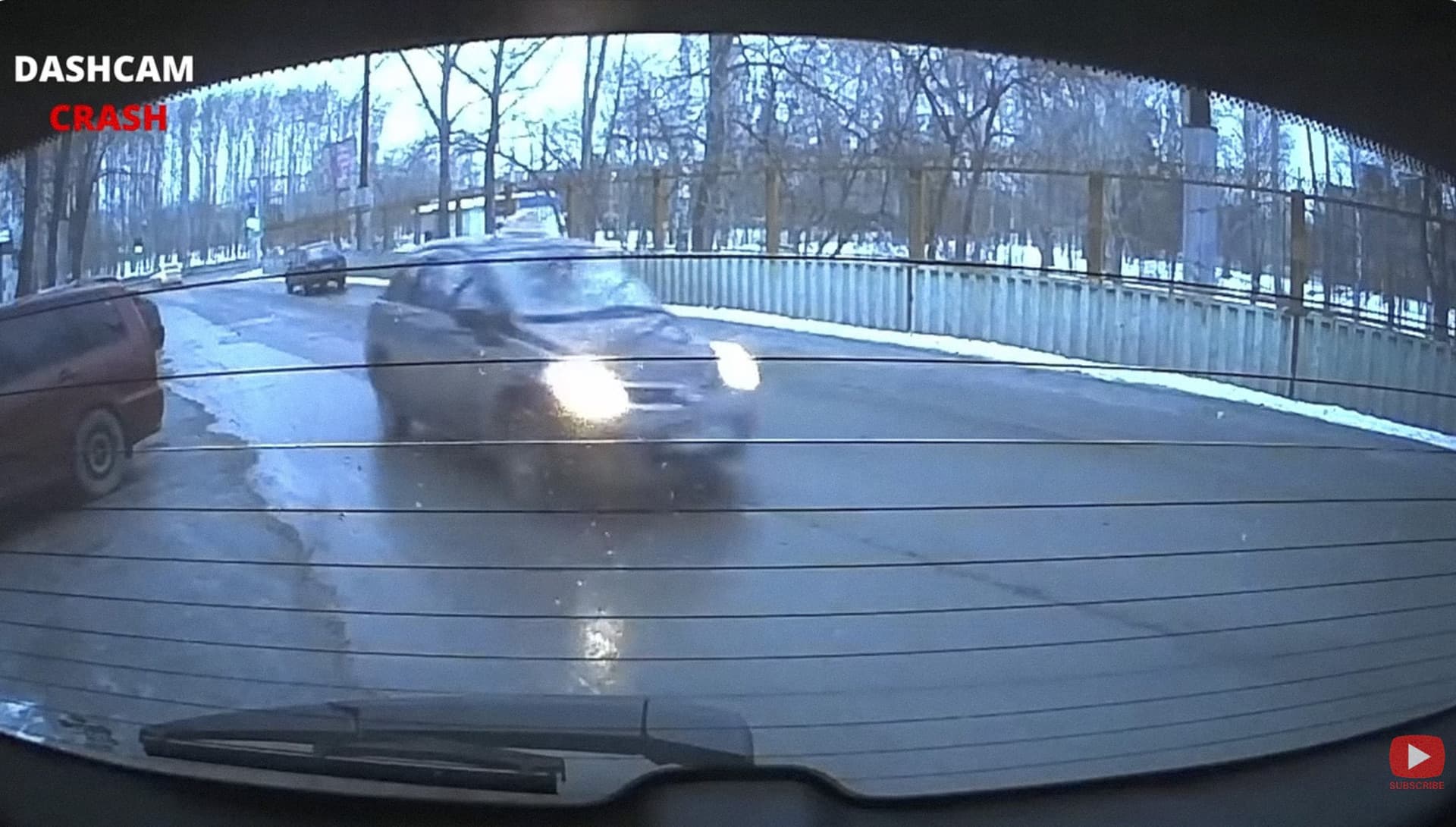
CRAZY RUSSIAN DRIVERS #5 – Dashcam Russia Compilation (2020), video's still.
The automobile and cinema were both born at the end of the nineteenth century, two machines of motion at the birth of modernity. Almost immediately, they found each other in the crash. In early US film, the car crash was less a warning than a happy accident. As film historian Julian Smith notes, of the more than 110 films depicting crashes or injury before 1920, only three or four end badly—the rest resolve in romance, reconciliation, or 1 In Lubin’s short film An Honest Newsboy’s Reward (1908), a poor boy is struck by a motorcar while returning a lost wallet; the owner, grateful for the boy’s determination, gives him a job. In Vitagraph’s short film After Midnight (1908), a young woman slips on ice and falls into the path of an automobile; a gentleman dashes into the street to save her, and the two soon fall in love. And when villains crash, justice is served, as in Edison’s Dashed to Death (1909), where the bad guy’s car plunges off a cliff, falling three hundred feet to the rocks below and bursting into flame, leaving what one Moving Picture World reviewer called “an unrecognizable mass of smoking wood, iron, and rubber.”
Julian Smith, “A Runaway Match: The Automobile in the American Film, 1900-1920,” in The Automobile and American Culture, ed. David L. Lewis and Laurence Goldstein, (University of Michigan Press, 1993), 179–92.
In 1959, Richard Wayman started showing real crashes to captive audiences of teenagers. A partner at the accounting firm Ernst & Ernst, he became interested in highway safety after a friend was killed in an accident. He installed a police scanner in his car and began photographing crash scenes around Ohio. He assembled the results into safety slide shows and distributed them to state trooper stations; a patrol superintendent, learning Wayman also owned a movie camera, suggested he make a film. Wayman founded the Highway Safety Foundation in Mansfield, Ohio, and assembled a crew of ambulance chasers who, with the cooperation of local police, filmed accidents across the state. The team produced a series of short, graphic films for high school driver education classes whose titles suggest an interstate giallo: Mechanized Death (1961), Wheels of Tragedy (1963), Highways of Agony (1969). By the early 1970s, forty million people had seen the foundation’s work, which continued to be shown in classrooms into the 1990s.
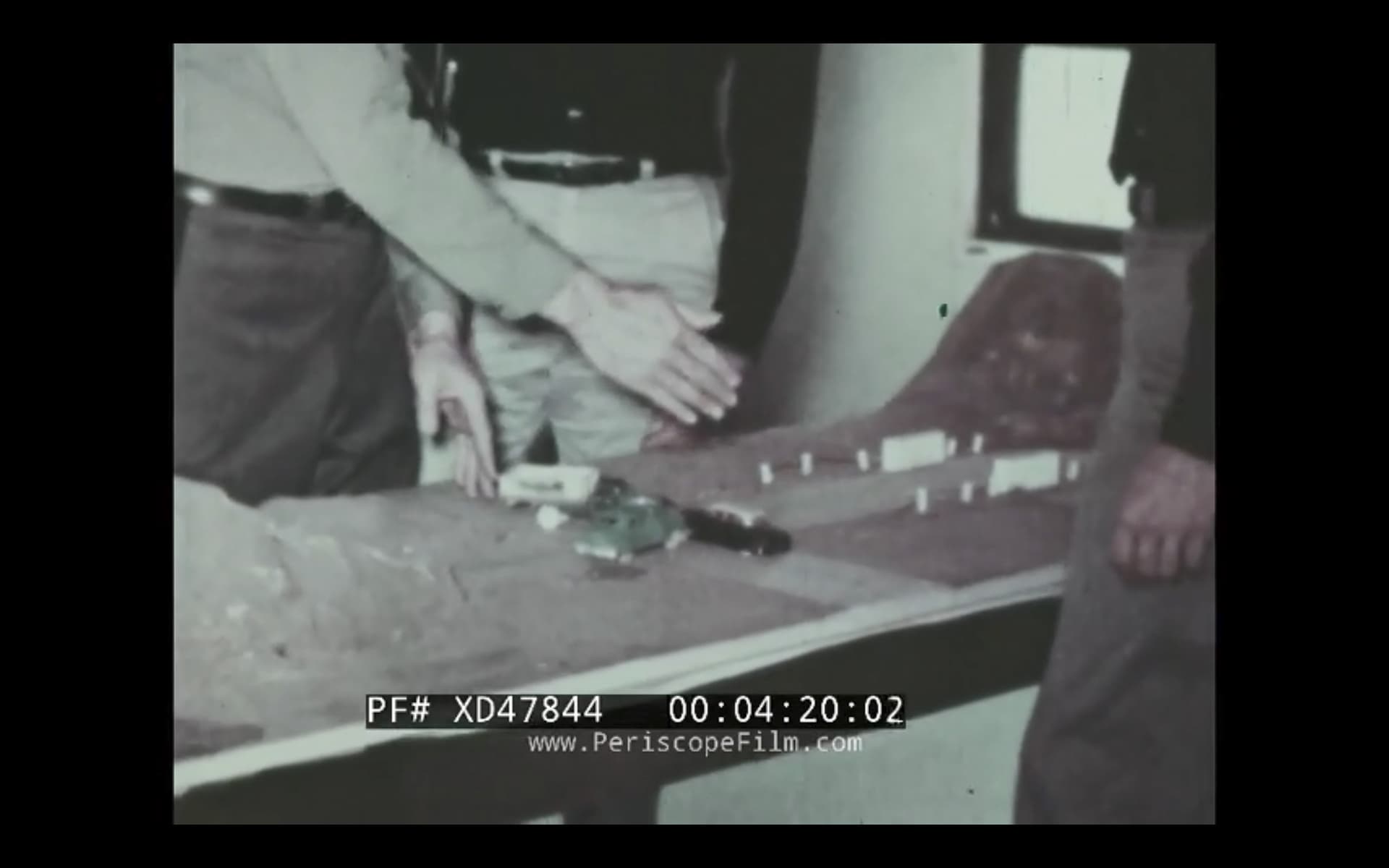
Signal 30 (Richard Wayman, 1959), video's still. Courtesy: PeriscopeFIlm.
Signal 30 (1959), the foundation’s first film, was named for the Ohio highway patrol’s radio code for a fatal crash. It opens with a disclaimer announcing that nothing has been staged, that the film’s quality is below Hollywood standards, and that, “also unlike Hollywood,” the actors weren’t paid—they “received top billing only on a tombstone.” What follows is twenty-eight minutes of crash aftermath on Ohio roads. A truck carrying cattle collides with a car of seven; rescuers dig a farmer’s charred remains from wreckage at a railroad crossing; a seventeen-year-old boy lies pinned beneath a red convertible. A deadpan narrator supplies commentary that moves between moral instruction and something closer to cruelty: “Almost every bone in his body is broken. He is very, very dead.” The brochure boasts that the film was shot “in living (and dying) color.”
This was a behaviorist theory of spectatorship: show carnage, produce fear, change behavior, save lives. But the ambition was grander than mere shock value. The foundation’s films aimed to produce a general consciousness of risk—to make a population aware of itself as an aggregate body that dies at a certain rate, under certain conditions, for identifiable reasons. Michel Foucault might have recognized this as a biopolitics of the roadway. “Every accident has, at its base, a violation of a traffic rule,” the narrator of Signal 30 announced. The problem was always the driver, never the car, never the compulsion to drive everywhere in America, a framing that the auto industry was only too happy to promote. For the next decade, deaths nearly doubled before they began to fall. And when they fell, it was largely due to the effects of safety regulations and social reforms, including seat-belt laws, drunk-driving campaigns, and new safety standards that emerged from the lawyer and activist Ralph Nader’s best-selling book Unsafe at Any Speed (1965), which exposed the auto industry’s broad opposition to safety improvements.
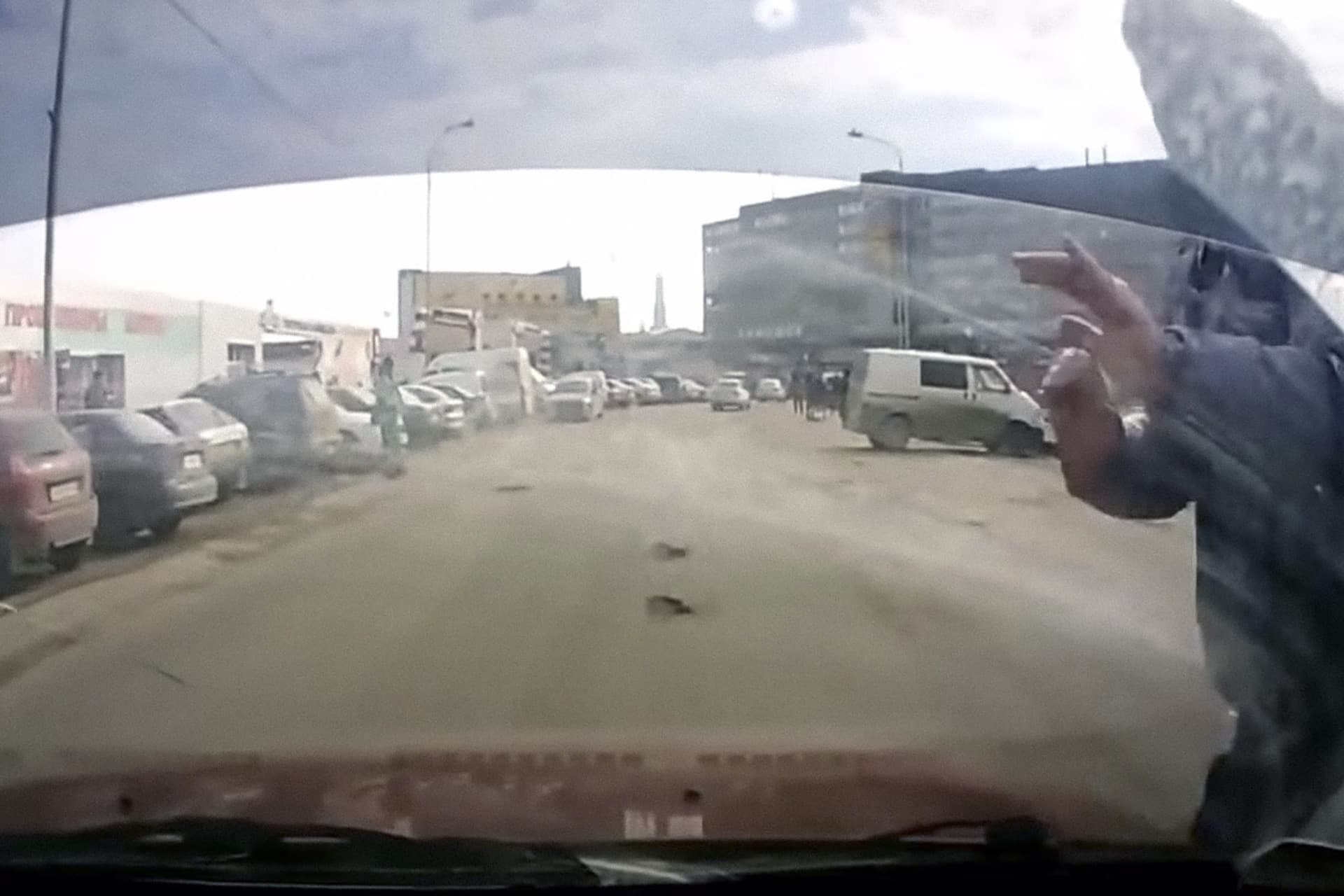
CRAZY RUSSIAN DRIVERS #5 – Dashcam Russia Compilation (2020), video's still.
The Highway Safety Foundation failed to produce better drivers. Instead, it produced better spectators. It trained audiences to look at a mangled body without turning away, to watch someone die without feeling obliged to do something about it, to process death as data rather than experience. Signal 30 and its offspring prepared people for what screen culture would eventually provide without limit: Faces of Death (1978), rotten.com, LiveLeak, r/watchpeopledie. The foundation cultivated an appetite that J. G. Ballard would recognize as his subject in Crash (1973). That Ballard’s Vaughan almost shares a surname with Wayman’s real-life partner at the foundation, Phyllis Vaughn, suggests that the line between civic duty and scopophilia was already blurred in Mansfield, Ohio. (Martin Yant, an ex-journalist and private investigator, later reported that the foundation’s bus had doubled as a studio for pornographic films.)
Both Wayman and Ballard’s Vaughan chased accidents. In Russia in the early 2010s, drivers simply had dashboard cameras continuously recording. The reasons were practical: corrupt traffic cops, rampant insurance fraud, courts that wouldn’t accept a driver’s word without documentary evidence. When a meteor exploded over Chelyabinsk in February 2013, it was captured from car after car, not because anyone was looking for it, but because millions of dashcams happened to be pointed in that direction at that moment. But mostly the cameras captured the mundanities of the daily commute—including car crashes, of course. Thousands of them, filmed from the driver’s perspective in real time. That footage was subsequently pulled off the cameras, spliced together, and uploaded to the internet, where Russian car crash compilations became a minor YouTube genre.
Under titles like “Russian Car Crashes,” “Best Fails from Russia,” “Epic Winter Accidents,” “Russians Being Idiots,” “Idiots in Cars,” “Russian Snow Failures,” and “A Normal Day in Russia,” the compilations stitch together dozens of clips into ten- or fifteen-minute supercuts. The footage has a distinct texture, nothing like the Highway Safety Foundation’s staged solemnity: gray skies, wet asphalt, Cyrillic road signs, the muffled sound of a car heater, a turn signal, Russian pop radio. Then a sedan drifts across the center line in slow motion; a truck jackknifes on black ice and swings its trailer into oncoming traffic; a pedestrian materializes from a snowstorm; a car brakes ahead, and the gap closes too fast. Some crashes are spectacular: head-on collisions that send debris careening across the frame, rollovers that seem to happen in zero gravity. Others are banal: a gentle rear-end tap at a stoplight, a fender crumpling against a guardrail. What unites them is what happens after the crash—the camera keeps recording. It stares at a buckled hood, a snowbank, a spiderweb of a shattered windshield. Sometimes you hear the driver breathing.
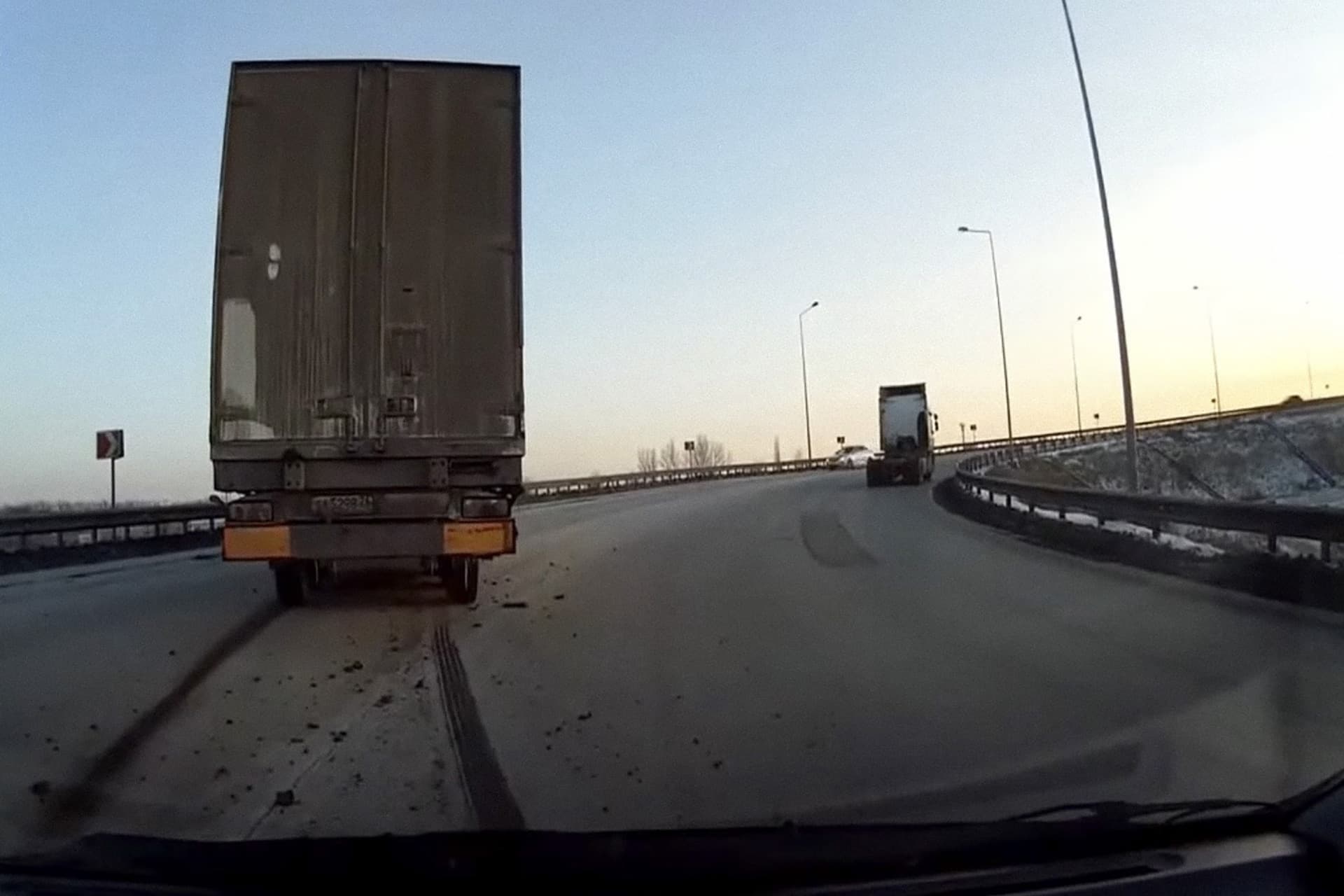
CRAZY RUSSIAN DRIVERS #5 – Dashcam Russia Compilation (2020), video's still.
The footage shares a visual language with the first-person perspective of video games: a fixed POV, the windshield as a screen, the hood at the bottom of the frame, the road receding to a vanishing point, obstacles approaching. But unlike a game, there is no objective, and no skill is being tested. And unlike Signal 30, there is no narrator, no moral claim, no pedagogical ambition. Fredric Jameson argued that in postmodern action cinema—films like The Terminator (1984), Lethal Weapon (1987), Die Hard (1988), Cliffhanger (1993), and Speed (1994)—narrative is condensed to “the merest pretext or thread on which to string a series of explosions.” He described a struggle internal to Hollywood in which the set piece—the explosion, the chase, the crash—gradually displaces the plot that was supposed to contain it. Even so, the pretext remains: a bomb, a villain, a ticking clock, something with which to weave together otherwise disconnected moments. That struggle disappears with dashcam compilations, not because violence overcomes narrative, but because the footage belongs entirely to the technical apparatus. The same temporal structure 2—pure present, self-contained rupture, no accumulation—emerged spontaneously from millions of insurance cameras on Russian roads. The exhaust of corruption, insurance fraud, and institutional failure exceeded the aesthetic form that film producers labored to construct.
Fredric Jameson, “The End of Temporality,” Critical Inquiry 29, no. 4 (2003): 714.
Signal 30 believed that the image of the crash could frighten viewers into submission. What it inadvertently demonstrated was the crash’s seductive power. Ballard pursued what the Highway Safety Foundation couldn’t. In Crash, he imagines the accident not only as bludgeoning, but as rewriting. Jean Baudrillard described this experience as the “anagrammatization” of the body. The wreck doesn’t destroy but disperses, scattering meaning across every point of contact between flesh and machine. Every gash left by a steering column, every bruise imprinted by a dashboard medallion, every scar where skin met chrome becomes a new site of 3. The Russian dashcam compilations inverted the foundation’s premise. They made the violence of the road completely visible and completely ignorable. Each clip the viewer survives—by being in another country, on another road, in another winter—confirms their distance from danger, even as it demonstrates how thin that distance is. The consciousness of risk proved perfectly compatible with the pleasure of watching.
Jean Baudrillard, “Ballard’s ‘Crash,’” Science Fiction Studies 18, no. 3 (1991): 316.
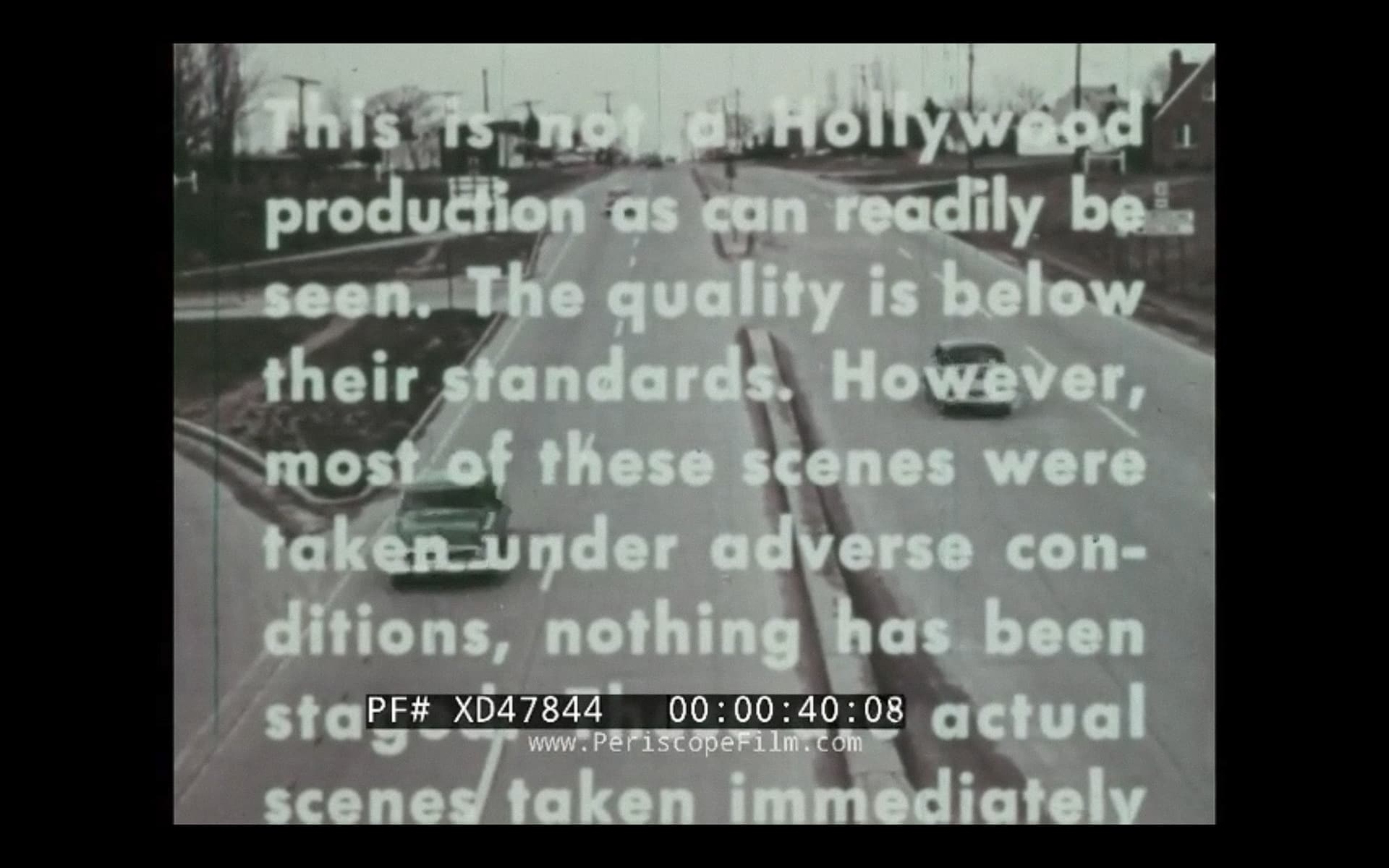
Signal 30 (Richard Wayman, 1959), video's still. Courtesy: PeriscopeFIlm.
When the Tesla struck Johna Story, the victim’s body was anagrammatized once more—not just across the site of the crash but across a neural network, dispersed into pixel values and probability thresholds that mysteriously failed to correct a lethal judgment: continue. Tesla conjures the viewer the Highway Safety Foundation wanted, and that Russian content creators never knew they were producing. It is Signal 30’s ideal student: a viewer whose behavior is fully constituted by the footage shown, with every frame of the training data metabolized into parameters that govern how it drives. And it is the dashcam compilation’s ideal spectator: processing each clip as rehearsal, a scenario the car itself might encounter, observed from the driver’s seat with the calculating rationality of a machine that knows it could be next.
Tesla was its own audience. Before, the circuit had run from crash to camera to viewer, and the viewer had been the problem: the one who needed to be frightened into caution, confronted with some dark recognition, or reassured by distance. Tesla solved for the viewer. It watched with total attention, from inside the car, and drove straight through. Somewhere, the latest model is learning from having killed. Johna Story was the only one on the highway who stopped for a wreck.
Michael Eby is a writer living in New York.
Julian Smith, “A Runaway Match: The Automobile in the American Film, 1900-1920,” in The Automobile and American Culture, ed. David L. Lewis and Laurence Goldstein, (University of Michigan Press, 1993), 179–92.
Fredric Jameson, “The End of Temporality,” Critical Inquiry 29, no. 4 (2003): 714.
Jean Baudrillard, “Ballard’s ‘Crash,’” Science Fiction Studies 18, no. 3 (1991): 316.
finanziato dall'Unione Europea - Next Generation EU