On Withholding
I find it's harder to write about art when you commission yourself. Once I've already asked permission to share my thoughts, it feels doubly difficult to formulate them properly. Triply when my intention is critical. Who asked for this? This judgmental moralism. I have a preference for effects in art; it's a kind of American pragmatism. If I were more fully employed, a columnist or something, would I feel more comfortable sharing this with you? Oh well, by the grace of the anointing editors I go.
I set out, pitched a piece about Fernanda Gomes and Trisha Donnelly. Both artists make installations, or works that work in formation. Installation is a tricky denomination of contemporary art. Gomes's work seems to go easy on language; there is not much to say. Gomes herself seems direct; she packs a suitcase and works in the space. Her press release is straightforward. Trisha Donnelly's work is heavy. It must be shipped, freighted, or moved with machines, or alternatively, it is almost ephemeral, and her oeuvre actively resists explanation. The artists' relationships to language reflect their approach in general; Gomes is immediate, Donnelly is withholding.
The juxtaposition of these artists is the result of my seeing two shows in close succession last November: Trisha Donnelly at the Museum für Moderne Kunst in Frankfurt am Main, and Fernanda Gomes' double show in Paris at Galerie Peter Kilchmann and Peter Freeman Inc. It is maybe inaccurate or unfair to compare (and despair) artists like this. I am also reluctant to frame their dissimilitude in relation to an oppositional arrangement of immanence and transcendence. Both because these ideas are not really opposites, and because it is generalizing to cast the southerner (Gomes) as generously immanent, and the northerner (Donnelly) as coldly transcendental, yet I am having trouble avoiding it.
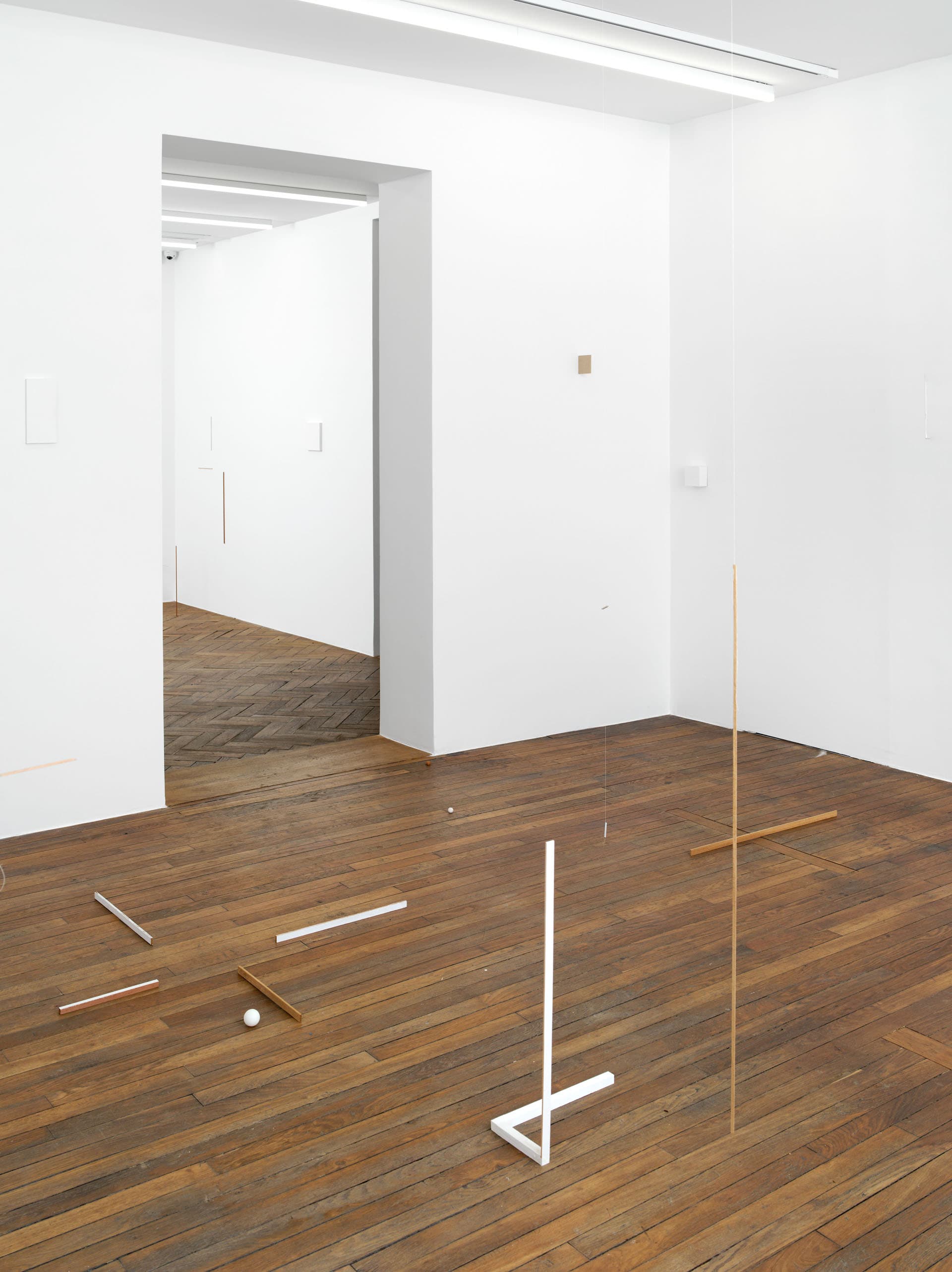
Fernanda Gomes, Galerie Peter Kilchmann, Paris, France, 2025. Photos: Aurélien Mole. Courtesy of the artist and Galerie Peter Kilchmann Zürich/Paris.
In Paris, Gomes' show felt like a warm embrace. The installation at Peter Kilchman in the Marais was full of atomized fragments of the space; everything was either white, like the wall, or brown, like the wood floor. Slivers hung in the air, creating imaginary volume everywhere. I walked a narrow path among art motes balanced near the ground. Between the floorboards, small matchsticks and seeds filled cracks.
At Peter Freeman, near the Palais Royal, the work took more of a cue from the gallery's glass facade, and when we arrived, it was raining. The windows were covered inside and out with white paper–oversized empty pages–some joined by ribbons that hung wet in the wind. The interior was mapped by small wooden formations that reminded me of children's block castles. One arrangement had a long, thin piece of wood leaning precariously from its parapet. A kind of reaching finger bobbed slightly in my way so that I had to pirouette around it as I progressed. On the far wall, a spotlight cast a rectangular shape, like a portal or a sunset, shaped like a door.
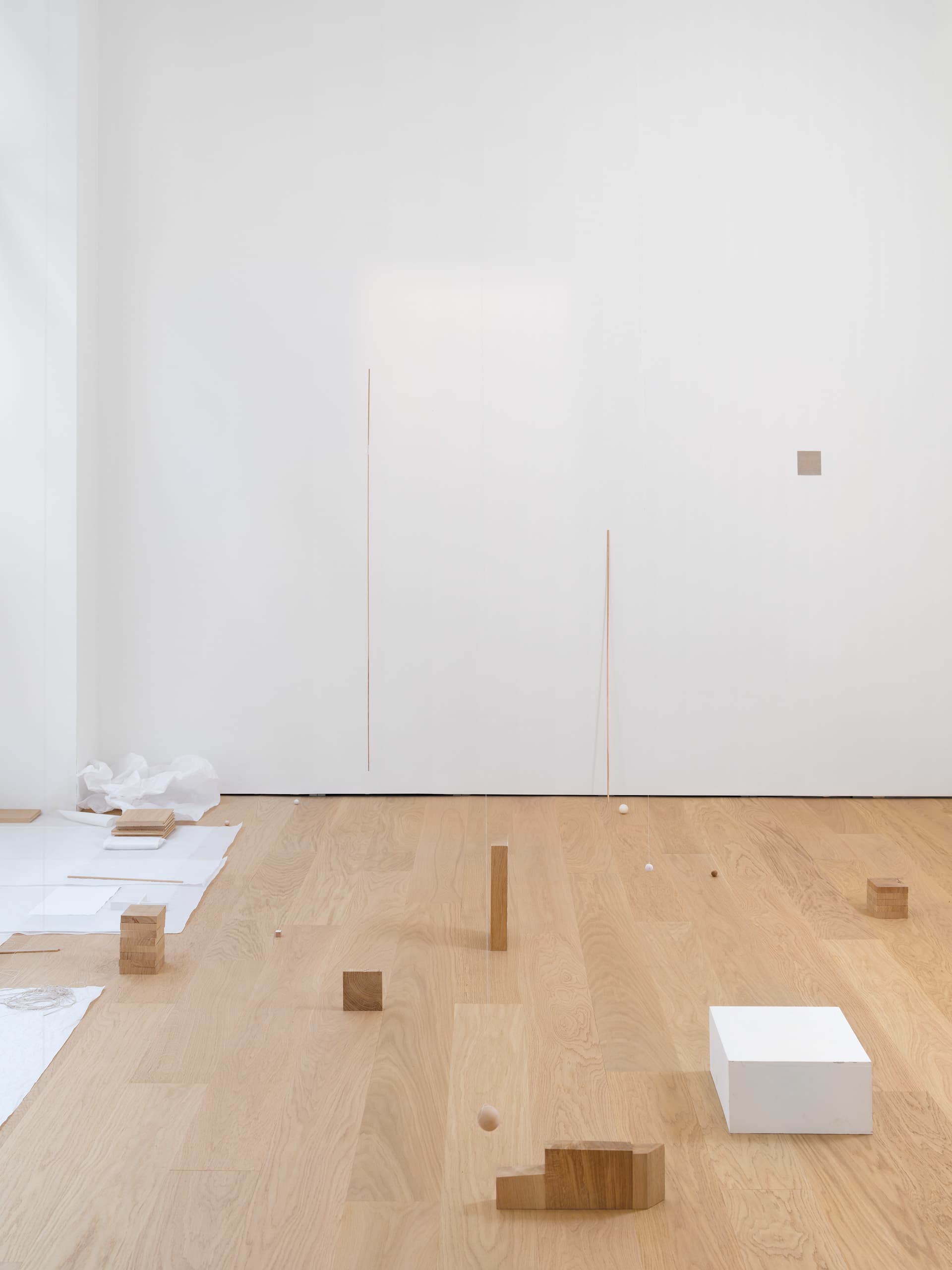
Fernanda Gomes, Peter Freeman, Inc., Paris, France, 2025. Photos: Aurélien Mole. Courtesy of the artist and Peter Freeman, Inc.
The works in both spaces seemed animated by an immaterial wind, like the infernal atmosphere of Marley's Ghost in Dickens' A Christmas Carol, which perturbs his skirts and hair. In Gomes, the presence is personified not by ghostly history but through the interaction of things, an eminence of relation.
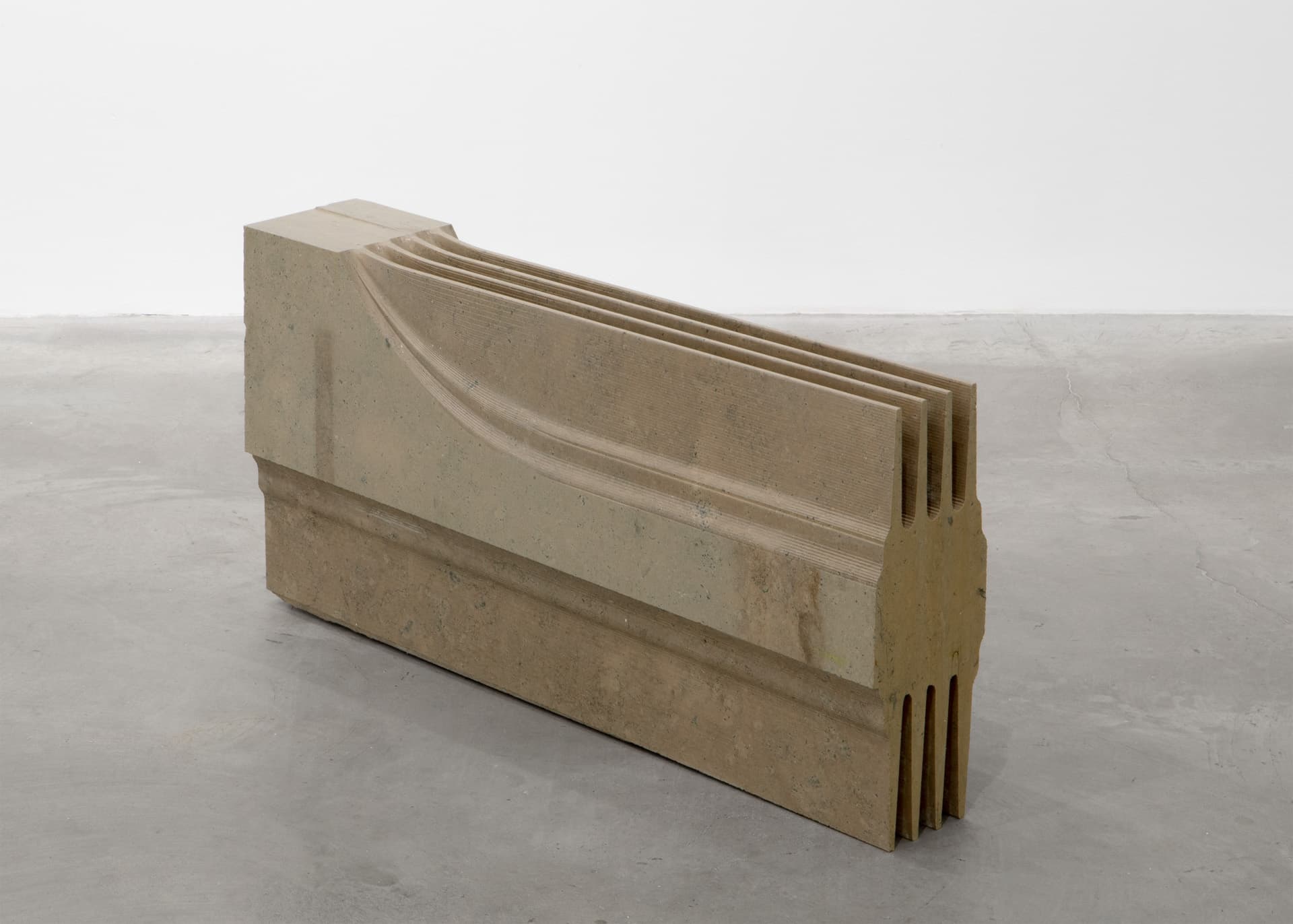
Donnelly's work and her show are actually hard to describe. The sparse language around it implies this as its most essential trait. The MMK Tower, where the show is held, is a large, cold concrete floor in the Commerzbank building in downtown Frankfurt. In the show, there are many of Donnelly's signature marble sculptures, evenly distributed throughout the space; squareish pieces of rock with long, rounded cuts or smoothed backs, more interested in blockyness than surface. The faces of the reliefs are resolutely mute like the static videos and awkwardly framed drawings elsewhere in the show–fragments of transmissions working against their medium: unplayable stone, grooved like vinyl records; videos of audio poised as photographs.
My favorite piece is the first you encounter upon entering, a thin vertical speaker shape in a cotton cover. It is one of three materially unique outliers; the other two are an oval wood desk and a pair of rouge Christmas garlands lurking behind a wall. The sleeve of the speaker announces the intentional silence of the space; embroidered onto it is an emoji-like hieroglyph or hexagram of volume bars suppressed by horizontal slabs.
That poetry succeeds where it fails is probably important to an interpretation of Donnelly. Canon in her mythology is a performance in which she rode into her own gallery opening on a white horse, dressed as a Napoleonic messenger, and delivered the speech Napoleon would have delivered himself at Waterloo–future archetype of all defeat–had he not fallen sick. That Donnelly's work is so tight-lipped but also elaborately mythologized is a paradox; maybe it is the paradox of her poetry. In the show, I specifically longed for titles, an olive branch to usher me into a communion with the work. A friend told me that Donnelly had allegedly gone around during the press preview, ripping the labels off the walls. The friend also then worried I would use the story "against" Donnelly. This struck me as strangely protective. Both the protectiveness and my friends' participation in Donnely's mythomania seemed like a bad sign, that something once mysterious and austere is curdling into cultishness.
I can believe in this work "address[ing] simple phenomena" as the short essay in the show's booklet claims, but I balk at the attendant mythology I am seemingly expected to bring to my experience. Why must I be so unmet in the space? Not that I want or expect popular accessibility, but at a certain point, so little will to accompany the viewer feels like arrogance or aggression. At the 'end' of the show, where the gallery meets a back elevator leading to the bank, there is a photograph of a cat and beneath it the only word in the whole exhibition: "sometimeses." That all of a sudden, here at the end, a meme is offered, emptied me out–delivered me unto desperation. The show's indifference to language, which I am skeptical of as a productive critique, turned into indifference toward the viewer.
Doubt keeps our boundaries. It is bad faith but effectively pragmatic. It is what respects the right to opacity in these works, distrusts my will to understand and assimilate. Édouard Glissant, the Martinican poet and philosopher, says: "The thought of opacity distracts me from absolute truths whose guardian I might believe myself to be…[it] saves me from unequivocal courses and irreversible choices."1 Glissant opposes a will to transparency with a right to opacity in people and cultures. What is important in our case is that the aim of Glissant's opacity is relation, and this is what has broken down in Donnelly's equation. What Donnelly protects through myth and occultism is something more like the opacity of religion. God is profound and unquestionable because he is absent, elsewhere, unreachable. Christians (for example) invest in the power of their faith in part because they believe in the superiority of the other world. Donnelly's obscurantism upholds a kind of Conceptualism that has come to be almost faith-based in this way. Power is derived from what is absent, symbolic. This dogma of withholding hierarchizes aesthetic regimes through a transcendental language of irreproachability rather than delivering on a promised immanent realism beyond language.
Édouard Glissant, Poetics of Relation (1990), trans. Betsy Wing (Ann Arbor: University of Michigan Press, 1997), from the chapter "For Opacity." The full passage reads: "The thought of opacity distracts me from absolute truths whose guardian I might believe myself to be. Far from cornering me within futility and inactivity, by making me sensitive to the limits of every method, it relativizes every possibility of every action within me. Whether this consists of spreading overarching general ideas or hanging on to the concrete, the law of facts, the precision of details, or sacrificing some apparently less important thing in the name of efficacy, the thought of opacity saves me from unequivocal courses and irreversible choices."
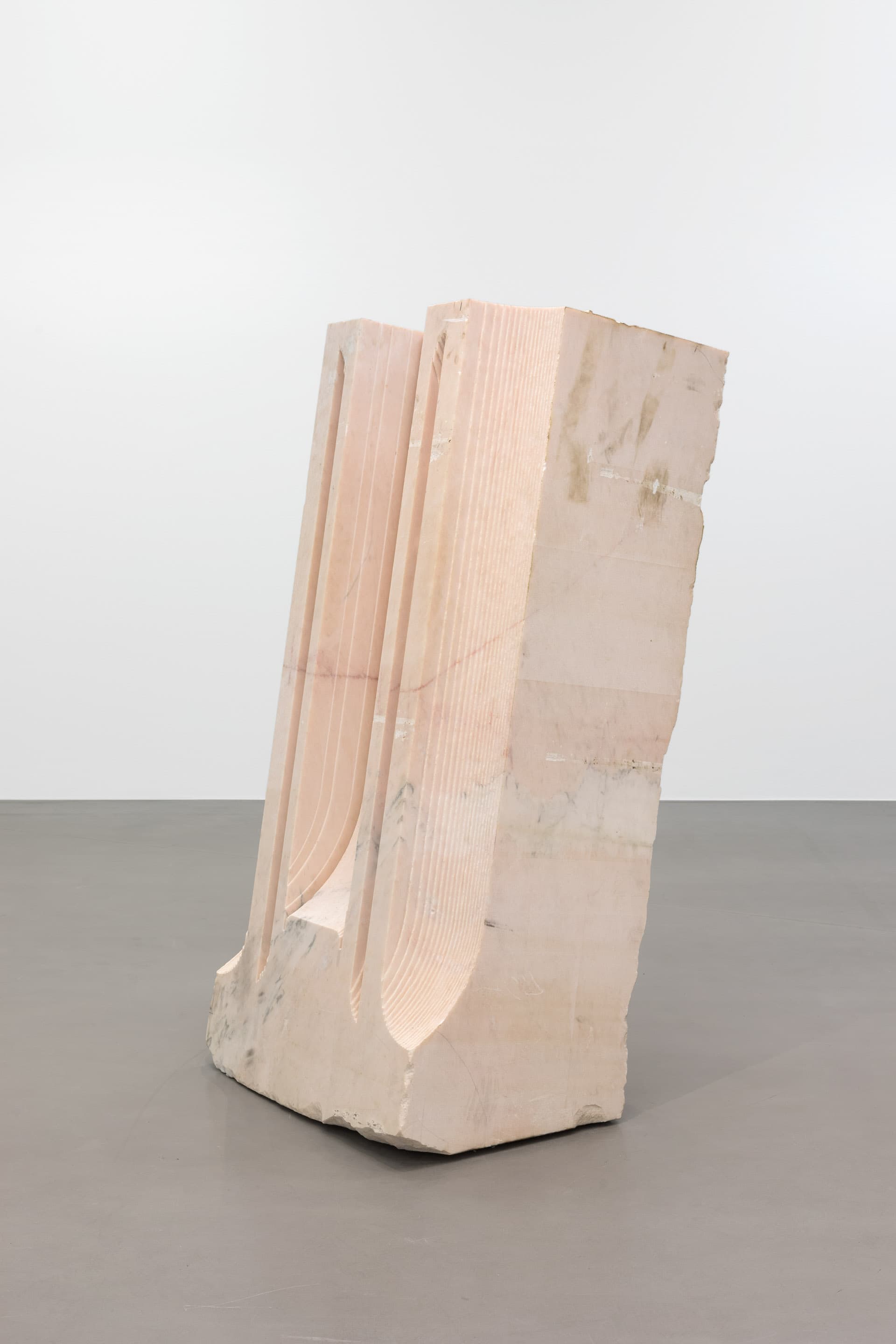
Installation view, Trisha Donnelly, MMK, Frankfurt, 2025.
While immanence is neither inherently virtuous nor geographically specific, a fetishization of transcendental absence does feel like a transatlantic North American–German art problem. Maybe Donnelly's austerity is a reaction to the exuberant, bare-chested expressiveness of the New York scene in the 1990s. A waffling between expressionism and conceptual minimalism might describe the general balance of North Atlantic art after 1945, but the cultural entanglement of Germany and America is even longer than all that.
American pragmatism as a philosophical tradition, as well as the originary organization of American institutions of higher learning (the PhD system, for example), was structured by the influence of German institutional and philosophical models on the 'first sons' of Boston Brahmin and Northeastern Protestant patrician elites sent abroad to Germany for their education. That Donnelly teaches, and that I was educated in Germany, probably explains the Hegelian turn this criticism has taken; it also indicates the site of the problem: educational systems rooted in modernism and Protestantism. Here, the absolute truths and unequivocal values that Glissant's opacity works against are reinforced by an opaque institutionalized intellectualism and interiority. Austerity in Donnelly's matter-of-factly mute works ends up in a quagmire of metaphysical essence, producing mystifying authority instead of grounding opacity.
That I have written so much more about Donnelly than Gomes still feels paradoxical. The editor asks if I am also withholding something. Why have I not remedied Donnelly's lack of language myself, with more description, for example? Which brings me back to what type of creative endeavor I am involved in as a critic. The work I want more language from (Donnelly) is the work that claims to transcend it and compels me to add to it. The work I more easily apply language to (Gomes) seems to need none. My critique isn't about a lack of language, but about the organization of context that language facilitates. I hesitate to go on about Gomes because, outside of the richness of my experience and my joy in relaying it to you, you had to be there; the experience had something to give. With Donelly, unfortunately, the addition of language feels almost as irrelevant as the presence of a viewer. I draw the two together in comparison because it was/is surprising that under the same emotional circumstances (anecdotal material I am withholding from you), two similar-seeming poetic intentions can land so contrarily.
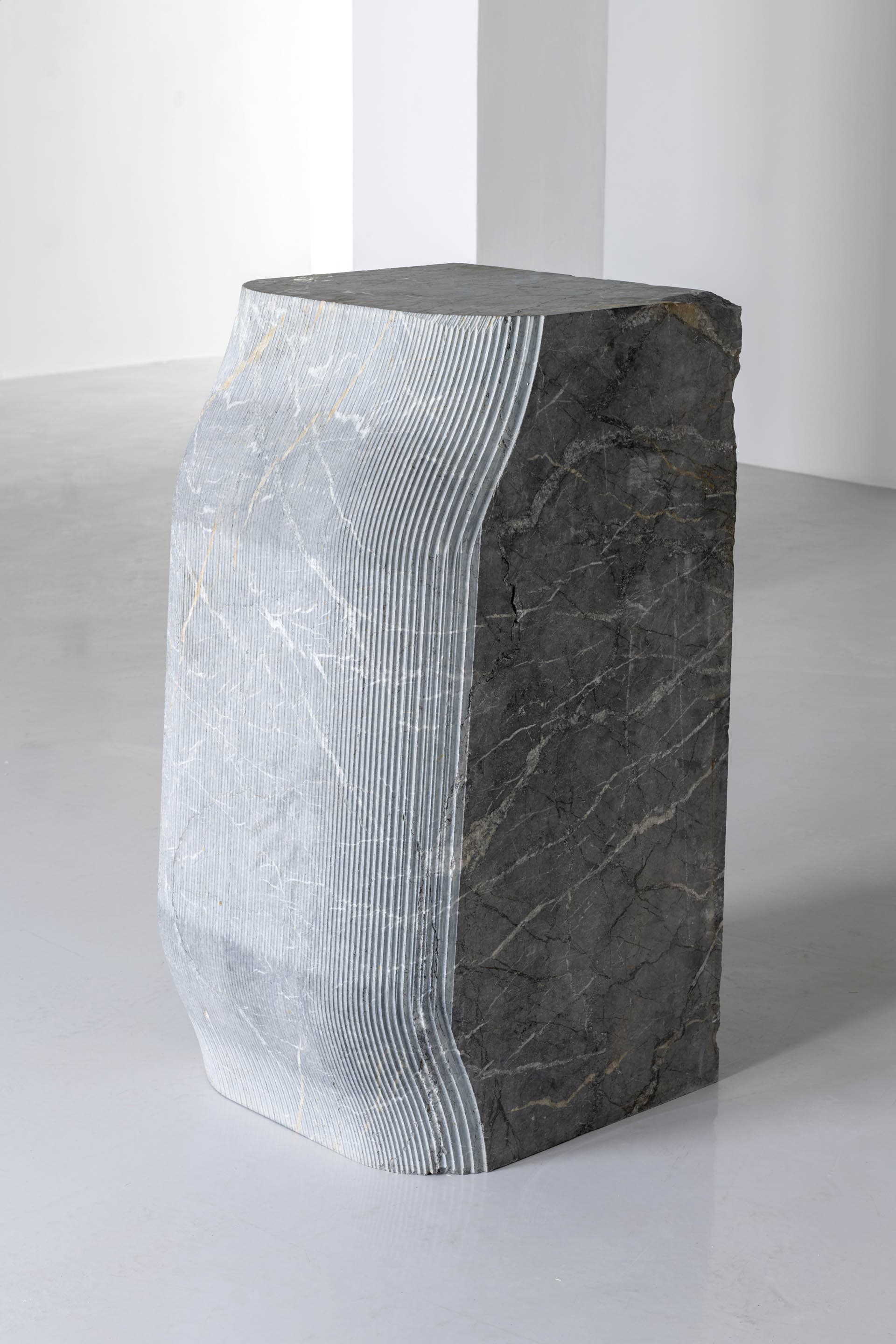
Installation view, Trisha Donnelly, MMK, Frankfurt, 2025.
Whether artwork means to meet us feels imperative. When so much culture is willfully aggressive to the viewer, why would I want art that addresses me so coldly? What should I do with work that seems to refuse my participation in its unfolding? Criticism is an egoist act of creation like any other, but it is one that draws its mana mainly from other creative acts. Maybe the writer is at the mercy of the artist. Maybe they should be; I am not in favor of separating the two. Such a power imbalance is likely what makes me sometimes mean and moralistic. As a viewer, I want to know that Donnelly cares about my experience of the work. As a critic, I am frustrated at the mystification that leaves even the initiated outside of a potential collaboration in understanding. This understanding is not even the production of meaning but just a meeting; something art, inanimate as it is, is uniquely capable of.
In Gomes's shows, I find every aspect demonstrates this possibility of encounter, even if small and humble. In Donnelly, I find a heroic recurrent assertion of its impossibility. While such negativity is historically understandable, it does not feel appropriate in the present (and, in my view, what is radical is always appropriate). Donnelly and I are institutionalized in a symbolic order that is currently falling apart; it is being brought down by its relationship to the faltering hegemony that has sponsored it. Maybe Gomes stands outside of this acculturation or traffic. Maybe that is again too geographically specific a reading.
Glissant's opacity helps protect us from "truths," ideas, bargains, and hegemonies of thought that no longer work. Intellectualism and art language are such truths–authoritative structures that remove us. Donnelly, I think, tries to work against these received ideas but fails when she fails to care for the viewer. When the encounter becomes secondary to the idea of the encounter, the real possibility of relating breaks down.
What justifies critique is timeliness. I love this John Cage quote, which is serious–like a rebuke–and probably also a joke. "Art is a complaint or do something else." Art is a complaint and something else. Whatever we do should aspire to be outside the pretension of critique yet within the possibility proposed by complaint. Bless the most expedient path to that, beyond language but aided by it as much as necessary.
Graham Hamilton is an artist and writer living in Paris, FR. His multidisciplinary practice spans floral arrangement, silkscreen, photography and sculpture, focusing on the tension between organic decay and preservation. Recent solo exhibitions include Memorabilia at Turiner Kunstverein?,Turin (2025); La Busta, basta at Gelateria del Sogni di Ghiaccio, Bologna (2025); and Why do I fill a box with flowers at Forde, Geneva (2025).
Édouard Glissant, Poetics of Relation (1990), trans. Betsy Wing (Ann Arbor: University of Michigan Press, 1997), from the chapter "For Opacity." The full passage reads: "The thought of opacity distracts me from absolute truths whose guardian I might believe myself to be. Far from cornering me within futility and inactivity, by making me sensitive to the limits of every method, it relativizes every possibility of every action within me. Whether this consists of spreading overarching general ideas or hanging on to the concrete, the law of facts, the precision of details, or sacrificing some apparently less important thing in the name of efficacy, the thought of opacity saves me from unequivocal courses and irreversible choices."
finanziato dall'Unione Europea - Next Generation EU